As an Amazon Associate, we earn from qualifying purchases. Some links on this site are affiliate links at no extra cost to you. Our recommendations are based on thorough research and editorial judgment.


The Difference Between AC and DC LED Systems

AC and DC LED systems differ in their power sources and efficiency. AC LEDs connect directly to alternating current, achieving about 95 lumens per watt. They simplify installation but have lower efficiency due to internal driver circuits. In contrast, DC LEDs utilize direct current from separate power supplies, reaching up to 125 lumens per watt. They enhance energy efficiency but complicate wiring. Understanding these differences can guide effective lighting choices, and further details can help optimize your selection.
Key Takeaways
- AC LED systems connect directly to AC power sources, simplifying installation and reducing cost by eliminating external drivers.
- DC LED lights require separate power supplies, enhancing energy efficiency with a higher output of up to 125 lumens per watt.
- AC systems achieve approximately 95 lumens per watt, while DC systems offer better efficiency and performance in demanding conditions.
- Maintenance-wise, AC LED systems pose higher shock risks, whereas DC systems are generally safer but may need external supply replacements.
- Future trends in LED technology include smart features and solar-powered solutions, with ongoing improvements expected to increase luminous efficacy beyond 150 lumens per watt.
Understanding LEDs and Their Operation
You may be interested



Light Emitting Diodes, commonly known as LEDs, are revolutionary semiconductor devices that produce light through a process called electroluminescence. They generate light when a current flows, leading to the recombination of holes and electrons. While LEDs operate best on direct current (DC), they can also function on alternating current (AC) by utilizing a driver for power conversion. This driver regulates the voltage and current necessary for efficient operation. Significantly, DC LEDs typically deliver higher energy efficiency because they lack the additional internal components often required for AC systems. The lifespan of both types remains lengthy, yet performance can diminish quickly if drivers are inefficient or voltage regulation is poor. Understanding these elements is essential for optimizing lighting systems. Modern 12-volt LED systems can achieve impressive lumens per watt efficiency ratings between 100-150, making them an excellent choice for energy-conscious applications.
AC LED Lights

AC LED lights represent a significant advancement in lighting technology, offering a straightforward solution for many applications. These lights connect directly to AC powered sources, simplifying installation by eliminating the need for external power drivers. Their integrated design enhances cost-effectiveness, as installation does not require additional equipment for power conversion. However, it is important to note that the overall efficiency of AC LED systems may be lower than that of their DC counterparts, due to internal driver circuits that can lead to some energy consumption loss. Commonly found in residential and commercial lighting fixtures, AC LED lights are a popular choice for general lighting needs. Nonetheless, users should consider compatibility with existing dimmers and lighting systems before selection. Modern AC LED systems can achieve brightness levels of up to 1200 lumens output when properly configured for optimal performance.
Recommended Products

MODERN DESIGN – This ET2 Lighting pendant delivers a refined, contemporary look that elevates any room in your home with timeless design appeal.

5-Level Wattage Selectable: This energy-efficient 2x4 led flat panel light five adjustable power settings (30W/40W/50W/60W/70W), letting you match brightness to different spaces. At 70W, it delivers up to 7700 lumens of bright, uniform illumination while helping reduce energy consumption

This 18-light chandelier consists of five layers of wooden lamp posts and countless matte white wooden strips that curve upwards from flexible iron arms. Slender metal branches are intricately arranged and finished in a soft ivory color.
DC LED Lights

While AC LED lights simplify many installations, DC LED lights offer distinct advantages that can enhance overall efficiency and performance. DC LED lights require a separate power supply, often utilizing batteries and solar panels. This setup allows for efficient operation, as DC LEDs consume less power and can reach up to 125 lumens per watt compared to the 95 lumens per watt typical of AC systems. Additionally, DC LED lights do not require internal driver circuits, further boosting their efficiency. They are particularly compatible with various dimmers and control systems, which enables precise control over lighting. Ideal for automotive and off-grid applications, these systems operate effectively under harsh conditions, benefiting from the direct electrical current that flows at DC voltage. Modern motion activation technology enhances these systems’ energy efficiency by automatically detecting movement within a 10-foot range.
Comparison of AC and DC LEDs
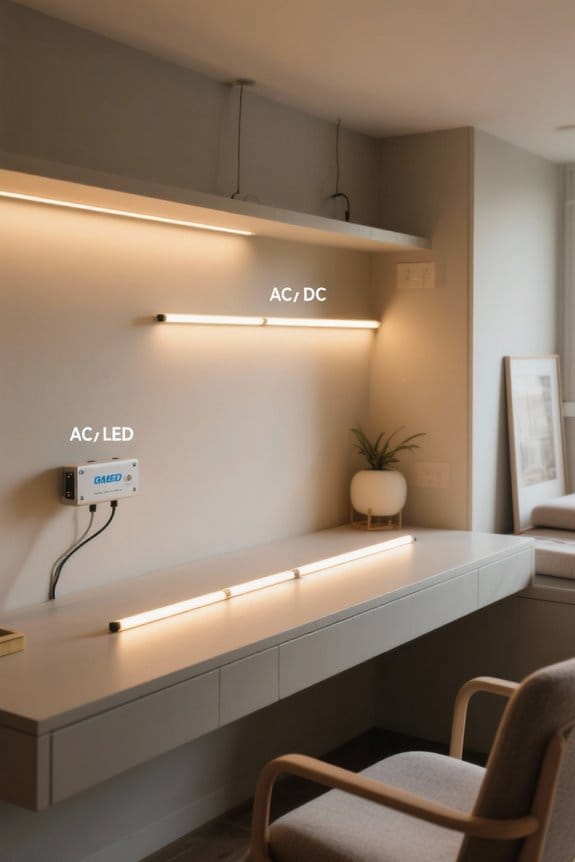
When evaluating the differences between AC and DC LED systems, it becomes evident that the choice between them greatly impacts efficiency and application suitability. AC LED lights connect directly to AC power sources, achieving approximately 95 lumens per watt (lm/W) with slightly lower efficiency due to internal LED drivers and circuit boards. Conversely, DC LEDs, requiring separate power sources like batteries or solar panels, can achieve around 125 lm/W, demonstrating superior energy efficiency. While both systems boast long lifespans, DC LEDs often show greater durability and stability in demanding settings. AC LEDs simplify installation, making them suitable for typical residential lighting, while DC LEDs excel in advanced applications requiring precise control, producing more lumens with less power consumption. Modern 24V LED strips can operate 30% more efficiently than their 12V counterparts, making them an ideal choice for energy-conscious lighting solutions.
Installation and Maintenance Considerations
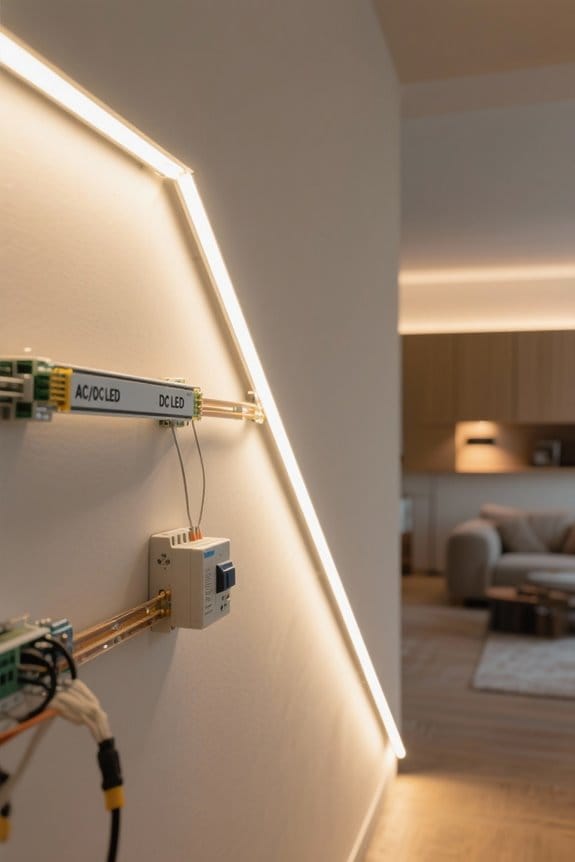
Selecting the appropriate installation method is critical for both AC and DC LED systems. AC systems connect directly to an AC power source, simplifying the installation process. Conversely, DC systems require separate power supplies, which complicate wiring configurations and can increase costs. Maintenance considerations also differ; AC systems, while easier to maintain due to their fixed wiring, present higher electrical shock risks during servicing. In contrast, DC systems use low-voltage sources, reducing shock hazards but potentially requiring the replacement of external power supplies. Additionally, AC LEDs may face compatibility issues with certain dimming solutions, whereas DC LEDs generally work well with various control technologies. Careful evaluation of these factors enhances the overall effectiveness and safety of an LED lighting system. Energy efficient LED systems can save up to 90% on power consumption compared to traditional lighting options, making them a cost-effective choice despite installation differences.
Efficiency Metrics of AC and DC LED Systems
How do the efficiency metrics of AC and DC LED systems compare? AC powered light emitting diodes typically achieve a luminous efficacy of up to 95 lm/W. In contrast, high efficacy DC LEDs can reach 125 lm/W, demonstrating superior power-to-light conversion. This disparity arises because AC LEDs employ internal LED drivers, which can reduce overall efficiency. Importantly, these drivers often perform below 71.6% efficiency for outputs under 50W, contributing to power losses during AC to DC conversion. Conversely, CENSE powered DC LEDs offer 6-7% higher electrical efficiency in practical applications. Over time, the average efficiency of DC LED systems leads to significant energy savings, making them more cost-effective despite higher initial installation complexity. Modern DC LED systems can achieve 50,000 hours lifespan while maintaining their high efficiency metrics throughout their operational life.
Flicker Monitoring and Its Implications
Flicker monitoring plays a critical role in evaluating the quality of LED lighting systems, particularly due to the adverse health implications associated with light flicker. High flicker rates, especially in AC powered LEDs, can lead to significant health impacts, including headaches and neurological problems. For instance, the % flicker in AC LEDs can reach 35%, while DC LEDs, such as those using CENSE power, exhibit a mere 2.5%. This drastic difference highlights the need for vigilance in flicker monitoring. Additionally, standards related to pulse-width modulation (PWM) frequency aid in measuring flicker effects. Understanding these measurements is essential for ensuring that lighting choices prioritize both quality and health, particularly in environments where consistent illumination is critical. Modern flame-retardant materials contribute to the overall safety of LED systems while ensuring proper heat dissipation and reduced fire hazards.
Benefits and Applications of AC and DC LEDs
Understanding the benefits and applications of AC and DC LED systems is critical for making informed lighting choices. AC LEDs offer ease of installation and cost-effectiveness, making them suitable for residential lighting. Their direct connection to AC power simplifies setup, ideal for quick installations. Conversely, DC LEDs are energy-efficient, achieving light efficacy rates of about 125 lm/W compared to AC’s 95 lm/W. This efficiency makes DC LEDs perfect for specialized applications, such as automotive lighting and smart lighting systems. Their compatibility with various dimmers allows for customizability in sophisticated setups. While DC LEDs may require additional wiring and a separate power source, the investment enhances safety and efficiency, particularly in projects demanding precision and advanced control. Modern DC LED systems can achieve 50,000 hours lifespan while maintaining optimal performance and reducing environmental impact.
Recommended Products

[UNLEASH 30,000A PEAK & INSTANT START]This heavy duty jump starter delivers 30,000A peak and 3,000A/1,500A rated current (12V/24V). It starts all gasoline engines and diesel engines up to 50.0L in 1 second, even from a dead battery. Powers trucks, construction and industrial equipment. Your critical-start assurance.

Package includes: 80X 24-LED Round Truck Tail Lightswith Wiring Plugs

Future Trends in LED Lighting Technology
The future of LED lighting technology is poised for significant advancement, with numerous trends shaping its evolution. Emerging smart features enable integration with IoT applications, enhancing convenience and energy efficiency. Manufacturers are developing tunable white and RGB+W systems, allowing users to customize lighting temperature and hue, creating dynamic environments tailored to various needs. In addition, ongoing improvements in LED driver technology aim to increase efficiency and compatibility, making installations versatile across AC and DC power options. Solar-powered LED solutions are becoming popular, promoting sustainable energy use especially in off-grid installations. As regulations tighten, innovations are leading to higher luminous efficacy, potentially exceeding 150 lumens per watt, maximizing light output while minimizing energy consumption. The landscape of LED lighting is truly transforming. Modern fixtures now offer Color Rendering Index ratings above 90, ensuring exceptionally accurate color representation in both residential and commercial applications.
Frequently Asked Questions
What Is the Difference Between AC LED and DC LED?
AC LED systems prioritize ease of installation and lower cost, while DC LED systems enhance efficiency and lifespan with better compatibility for various applications. AC LEDs are easier to use, whereas DC LEDs offer superior brightness and power management.
Do LEDS Need DC or AC?
Over 80% of LED systems operate on DC, offering remarkable energy efficiency compared to AC alternatives. DC voltage advantages include better circuit design considerations, reduced heat dissipation, and enhanced lifespan, impacting various lighting applications and cost implications considerably.
What Is the Difference Between AC and DC Systems?
AC and DC systems differ in power sources and circuit design, affecting lighting efficiency and energy consumption. AC often proves less cost-effective, while DC offers superior lumen output and thermal management, influencing market trends and application differences.
Can an AC LED Bulb Work on DC?
Ironically, an AC LED bulb thrives on AC power, yet attempts to function on a DC power source may lead to inefficiencies. Dimming capabilities falter, and voltage variations challenge its bulb circuitry design, complicating energy consumption further.