As an Amazon Associate, we earn from qualifying purchases. Some links on this site are affiliate links at no extra cost to you. Our recommendations are based on thorough research and editorial judgment.

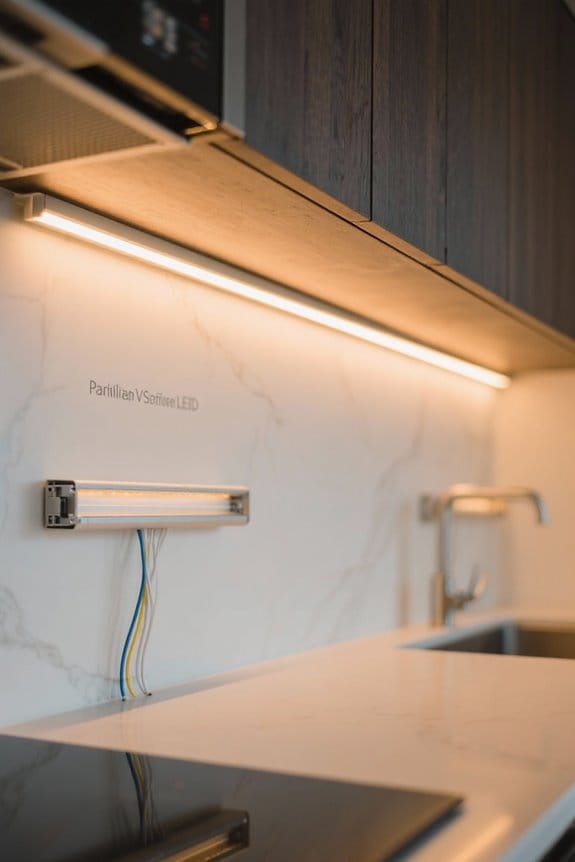
Parallel Vs Series Wiring for LED Strips

When wiring LED strips, understanding the differences between series and parallel connections is essential. Series wiring connects strips sequentially, requiring the total voltage to equal the sum of each LED’s forward voltage. This may cause voltage drops, reducing brightness. In contrast, parallel wiring independently connects each strip to the power supply, providing consistent voltage and brightness across all strips. Each method has advantages and disadvantages, influencing installation choices. Explore these wiring techniques further to optimize your LED strip setups.
Key Takeaways
- Series wiring connects LED strips sequentially, creating a single path for current, while parallel wiring connects each strip independently to the power supply.
- In series, the total voltage required is the sum of each LED strip’s voltage, risking voltage drops, whereas parallel ensures consistent voltage across all strips.
- Series connections can lead to reduced brightness farthest from the power source, while parallel wiring maintains brightness throughout even long installations.
- A failure in one LED strip disrupts the entire series circuit, but parallel wiring allows other strips to function normally if one fails.
- Use parallel wiring for longer runs to prevent voltage drops, ensuring better efficiency, while series wiring is simpler but less flexible for extensive setups.
Overview of LED Strip Wiring
You may be interested



Understanding how to wire LED strips is essential for achieving ideal lighting results. When connecting LED strips, you can use either a series connection or a parallel connection. In a series connection, the total voltage requirement equals the sum of each LED’s forward voltages. Conversely, in a parallel connection, each strip receives the same voltage from the power supply, preventing voltage drop issues common in series setups. Voltage drop can result in uneven brightness, especially in long runs. A properly selected power supply is vital; for a 5 watts per foot LED strip running 200 feet, a 24V DC power source must supply around 40 amps. Understanding these connections is vital for an effective lighting system. Quality LED strips can provide 20,000 to 50,000 hours of reliable illumination when properly wired and maintained.
Understanding Series Wiring
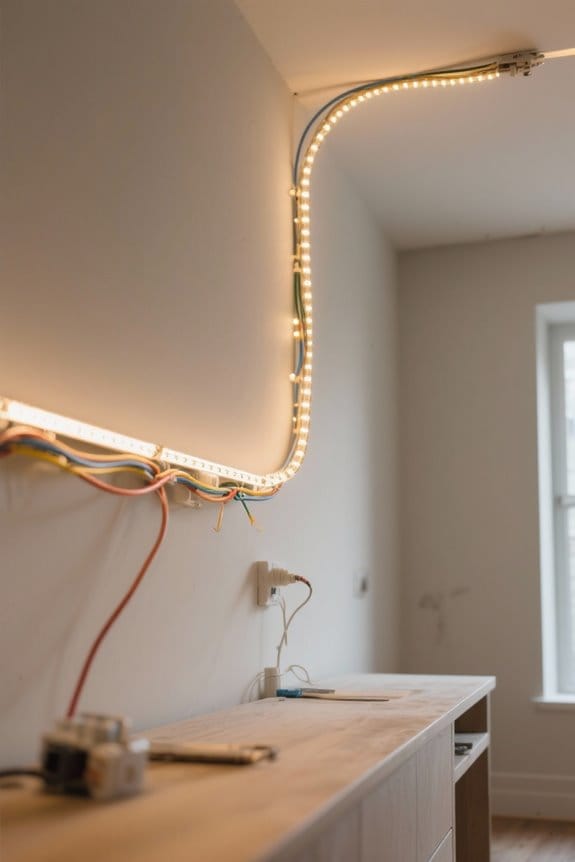
Series wiring connects LED strips in a sequential manner, creating a single path for current flow. This configuration requires the total voltage to equal the sum of the forward voltages of each LED. For instance, if three LEDs with a voltage of 2.95V each are used, a minimum of 8.85V is necessary to power the entire circuit. While series wiring simplifies connections and promotes uniform current distribution, it poses a significant risk: the failure of one LED can disrupt the entire circuit, leaving all downstream strip lights inert. Additionally, voltage drop can be problematic in longer runs, causing LEDs farthest from the power supply to exhibit diminished brightness. Proper planning regarding distance and wiring is essential for consistent performance. For reliable mounting in series configurations, waterproof mounting clips provide enhanced durability and protection against environmental factors that could compromise the circuit.
How to Connect LED Strips in Series
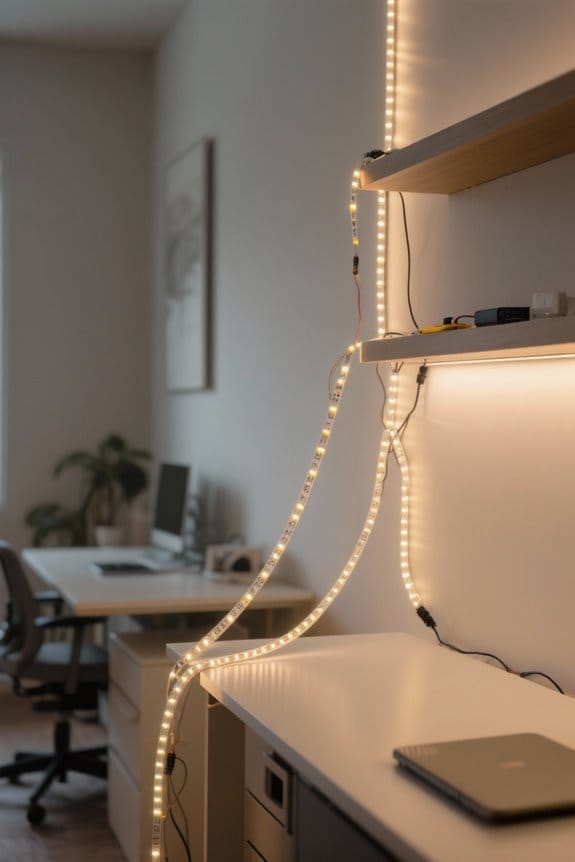
Connecting LED strips in series requires careful attention to detail to guarantee functionality and safety. To initiate a series connection, link the positive terminal of one LED strip to the negative terminal of the next. This configuration creates a single path for current flow, simplifying the lighting installation. Calculate the total voltage needed by adding the forward voltages of each LED; for example, three LEDs requiring 2.95V will need at least 8.85V. Monitor the maximum length of the strips to avoid voltage drops that can diminish light output. Each LED will share the same current, ensuring uniform brightness; however, one failed LED can disrupt the entire circuit. Always check polarity and use adequately measured wires to assure proper connections. Most 24V LED strips operate 30% more efficiently than their 12V counterparts when wired properly.
Recommended Products

WATERPROOF WHITE LED TILE LIGHTING Designed for seamless corner installation in tiled walls of showers, bathrooms, or kitchens. Provides warm white 3000K color temperature for cozy, inviting illumination with IP67-rated protection.

WATERPROOF LED LIGHT KIT FOR TILED EDGES Designed for flush installation into tiled surfaces like showers, kitchen backsplashes, and bathrooms for a seamless integrated lighting effect.

Product 1: High Waterproof Performance: This triple row led light bars feature IP67 waterproof rate dust-proof quake-proof anti-explosion Durable to withstand any harsh condition life span over 50 000 hours
Advantages of Series Wiring
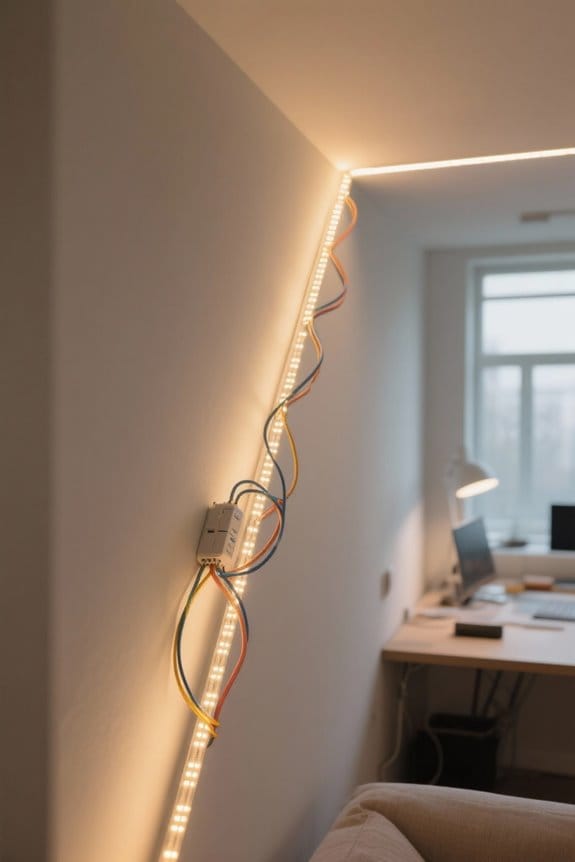
One significant advantage of series wiring for LED strips is the streamlined installation process it offers. By connecting multiple LED strip lights to a single power source, users reduce wiring complexity. This method guarantees uniform brightness across all strips, as the consistent current flows throughout the circuit. Moreover, series wiring can accommodate higher voltages, making it suitable for longer installations without needing additional power supplies. Troubleshooting becomes straightforward since if an individual LED fails, the entire circuit goes out, pinpointing the issue easily. Additionally, series wiring typically incurs lower initial costs, since fewer components are required when powering multiple LED strips from a single driver output. Consider these benefits when choosing your wiring method for LED strip projects. The extended LED lifespan of 25,000 hours makes series wiring an efficient long-term solution for accent lighting installations.
Recommended Products

【1】ULTRA-BRIGHT RGB ADDRESSABLE LEDS - 8 rolls of double-sided quad-row strips deliver vivid, high-purity colors with 16 million customizable hues. Features dynamic chasing modes, DIY effects, and over 100 pre-programmed light shows for eye-catching vehicle customization

【HIGH QUALITY CREE LED CHIP】Original Cree LED chip, More Brighter, Longer life span! This low profile LED light kits will boost your night time driving efficiency as well as turn heads. Powerful Cree LED chips up to 50,000 hours life-span
【Ultra-Bright Quad Row Visual Feast】 Features high-purity LED chips arranged in four dense rows for an eye-catching display. With over 100 dynamic effect programs, including multiple solid colors and chasing modes, it makes your vehicle stand out day or night.
Disadvantages of Series Wiring
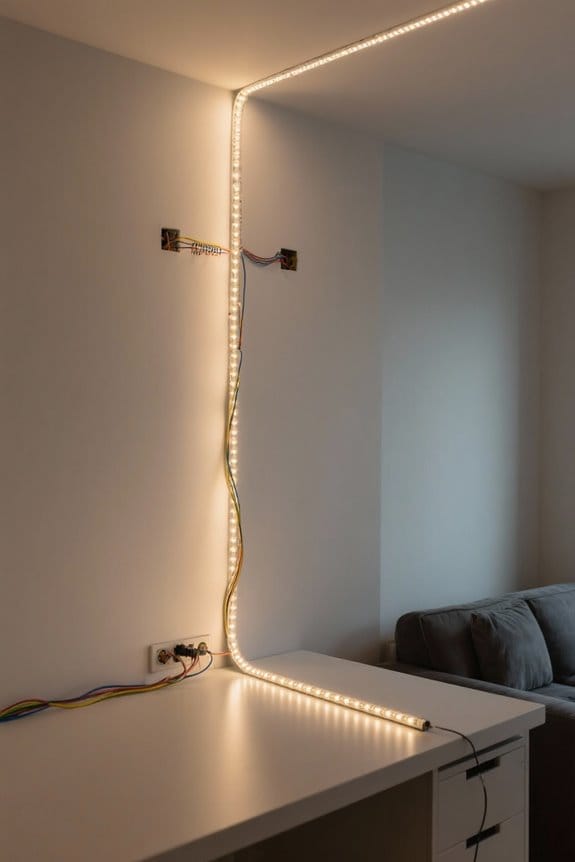
While series wiring presents several benefits for LED strip installations, it also harbors notable disadvantages that should not be overlooked. In a series circuit, a single point of failure can disrupt the entire setup; if one LED fails, the whole circuit stops functioning. This can lead to voltage drops along the strip, causing decreased brightness in LEDs positioned furthest from the power source. Additionally, uneven lighting effects may arise since the current flow varies through each LED, increasing the risk of LED failure. Installation flexibility is also limited, as the total length of the LED strip must adhere to specific voltage requirements. Although troubleshooting is relatively straightforward, any failure interrupts current flow, complicating repairs in extensive installations. Proper voltage compatibility between the power supply and LED strips is crucial, as common voltages of 12V or 24V must be precisely matched to prevent system failures.
Understanding Parallel Wiring
Parallel wiring for LED strips offers a reliable method for powering multiple strips efficiently. In this configuration, each LED strip is independently connected to the power supply, guaranteeing uniform voltage delivery across all strips. This helps prevent voltage drop issues, especially in longer installations, as each strip receives ideal voltage directly. Additionally, parallel wiring can lower the total current through each strip, reducing failure risks if one strip malfunctions. When implementing this setup, confirm the power supply can handle the cumulative current demand of all strips. Proper installation is key; using wire splitter terminal blocks facilitates multiple independent connections, guaranteeing effective current sharing and consistent performance across all connected LED strips. Prioritize careful management during installation for best results. Most energy efficient LED configurations can provide up to 50,000 hours of reliable operation when properly wired.
How to Connect LED Strips in Parallel
Connecting LED strips in parallel requires careful planning and precise execution to guarantee peak performance. Begin by determining the required input voltage for your LED strips. Each strip should independently connect to the power supply, making sure the positive and negative outputs align with the correct terminals. Use appropriate wire gauge to prevent overheating and electrical hazards. For installations needing multiple connections, utilize wire splitter terminal blocks to manage outputs effectively. This method greatly reduces voltage and current drop, maintaining consistent brightness across strips in parallel. Remember, as each strip shares the total current output, it enhances collective reliability. Verify compatibility when selecting connectors to guarantee peak performance across all segments of your setup. These efficient parallel configurations can provide 80% less power consumption compared to traditional lighting solutions while maintaining optimal brightness levels.
Recommended Products

The Jetson Nano Developer Kit delivers high-end computing performance to run modern artificial intelligence workloads at a previously minimal form factor, power, and cost. Developers, learners, and makers are now running AI frameworks and models for applications such as image classification, object detection, segmentation, and speech processing.

MICTUNING Brand New White Housing C2 MAX Rock Lights - Since 2013, MICTUNING has been committed to the research and development of LED rock light, and become the market pioneer and leader. In 2020, we designed and launched a purest and brightest C2 rock light, which was deeply loved and respected by customers. After 3 years of innovative research, in 2023 we added dynamic DIY function on the basis of C2, and newly launched this RGB+IC C2 Dynamic Color Rock Lights

Super Bright LED Strip -> 120 LEDs/M SMD2835 of high Illumination are adopted for this 110-130V led strip light. Higher manufacturing skills of series-parallel wiring configuration make a more stable configuration and uniform glow distribution, hence named as ProSelect LED light strip.
Advantages of Parallel Wiring
When considering the wiring options for LED strips, the advantages of using a parallel configuration become apparent. In a parallel setup, each LED strip receives the same voltage, promoting consistent light output across all strips, irrespective of distance from the power supply. This guarantees minimized risk of voltage drops. Additionally, parallel wiring allows for independent operation; if one strip fails, others remain functional, enhancing reliability. Safety is also improved, with reduced overall current in each segment decreasing the likelihood of total failure from excess current. By employing specialized wire splitter terminal blocks, installers achieve a flexible solution, ideal for longer runs of LED strips, eliminating thermal runaway and maintaining even lighting throughout the installation. Energy efficient LEDs can maintain consistent brightness levels between 500-1000 lumens when properly wired in parallel configurations.
Recommended Products

TORCHSTAR StableShine Series - Super Cost-Effective CRI90 Cabinet Light

120º beam angle provides even light distribution - perfect for coves and numerous accent Lighting applications
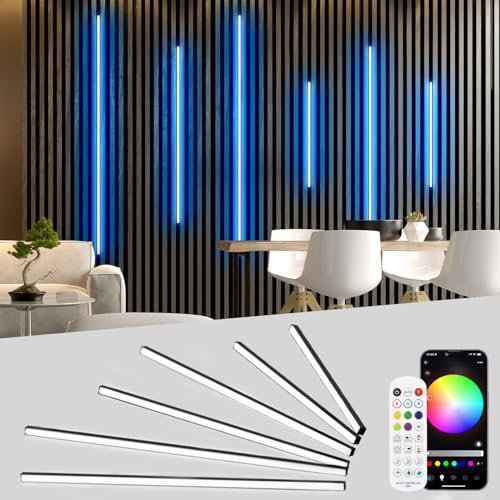
6 Pcs RGB Black led recessed lights for acoustic panel: The black acoustic panel LED Strip measures 0.394 * 0.394 in and is available in various lengths, including 16 in, 24 in, and 36 in. Each configuration accommodates six parallel led panel lights. The LED strip's input cable is 2 M/6.56FT , allowing for more flexible wiring options. The black smart recessed lighting is particularly suitable for acoustic panels, slat wall panel, wooden acoustic panels, cabinet and shelf lighting
Disadvantages of Parallel Wiring
While parallel wiring offers several benefits, it also presents notable disadvantages that must be carefully considered. The complexity involved in wiring LED strips connected in parallel is significant, often resulting in higher costs for components like wire splitter terminal blocks. Uneven current distribution can arise if strips exhibit differing characteristics, leading to performance discrepancies. Moreover, if one strip fails, it may cause overcurrent conditions in the others, increasing the risk of failure. The power supply requirements grow accordingly, since the total current demand is the sum of all strips; this may necessitate a higher wattage rating. Additionally, heat dissipation management becomes essential, as the increased amount of current can generate excess heat, potentially impacting the longevity of the LED strips.
Voltage Drop and Current Distribution
Understanding voltage drop and current distribution is vital for effective LED strip installations. In series wiring, voltage is shared among strips, which can cause considerable voltage drops over long runs. A voltage drop exceeding 5% can greatly diminish brightness, particularly for LEDs furthest from the power supply. Conversely, parallel circuits maintain consistent voltage across all connected LED strips, ensuring uniform brightness regardless of distance. Here, current distribution increases with more strips, drawing adequate power from the supply. For ideal performance in extensive installations, using parallel configurations is preferable, as it mitigates voltage drop while sustaining brightness levels. Therefore, evaluating wiring methods is essential to maintaining desired lighting outcomes in any LED project. Modern high-efficacy LED strips can provide up to 1,561 lumens while maintaining energy efficiency for optimal lighting performance.
Best Practices for LED Strip Installation
Proper installation of LED strips is essential for achieving perfect lighting performance and longevity. Verify the power supply voltage matches the LED strips’ specifications, utilizing voltage DC ratings appropriate for your project. When connecting LED strips in series, consider using parallel wiring for long runs to prevent voltage drop and maintain uniform brightness. Always cut along designated lines on the strip lights in series to preserve circuit integrity. Utilize solderless connectors and appropriate gauge wires to securely connect an LED strip, guaranteeing reliable electrical current flow. Regularly inspect all connections and components for wear to sustain performance and safety. These practices will enhance the efficiency and lifespan of your LED strip lighting system, providing ideal illumination in your space. For optimal performance, select strips with adjustable color temperatures to customize lighting across warm white, natural, and cool white options.
Recommended Products

6‑Piece Warm White LED Strip Lights for Acoustic Panels : Includes two 16in, two 24in, and two 36in black aluminum LED strips — perfect for acoustic wall panels, wood slat walls, cabinets, or bedroom accent walls. Connect up to 6 strips in parallel using the included splitter for a clean, linear lighting effect. No complicated wiring needed
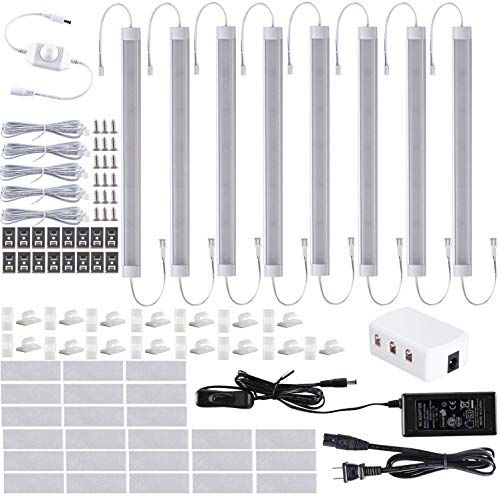
High Quality Materials--The under cabinet lighting have nice aluminum frames and are thin yet sturdy.Aluminum PCB with aluminum heat-sink and diffuser.The under cabinet lighting are the perfect, affordable answer to areas where you need more light but are on a budget. Great compact lights that allow a lot of possibilities.This under-counter light fixture is great for lighting up any space in your home or dorm.

【10/2 AWG Pure Copper Wire】The 10AWG 2 Conductors wire uses oxygen free copper as the conductor for the power and ground wires.Premium pure copper construction delivers superior conductivity,lower resistance,and improved performance over CCA wire.
Frequently Asked Questions
Is It Better to Connect LED Strips in Parallel or Series?
For ideal lighting consistency factors and to minimize voltage drop impact, parallel LED strip configurations are preferred. They enhance current distribution effects, ease installation, facilitate troubleshooting, and improve cost efficiency compared to series connections.
Should I Wire My Lights in Series or Parallel?
Wiring lights in parallel enhances current flow, minimizes voltage drop, and improves circuit safety. It promotes LED longevity, eases installation tips, and simplifies troubleshooting issues, making it the preferred choice over series configurations for lighting solutions.
When to Use Series Vs Parallel?
To determine when to use series or parallel wiring, consider wattage considerations, voltage drop, maximum length, and brightness consistency. For ideal heat management and circuit protection, controller compatibility and installation tips are essential.
What Will Happen if He Connects 100 LEDS in Parallel?
Connecting 100 LEDs in parallel enhances brightness uniformity and guarantees consistent voltage. However, increased current draw and wiring complexity pose risks of heat generation and lifespan issues, necessitating careful power supply considerations to prevent overload.